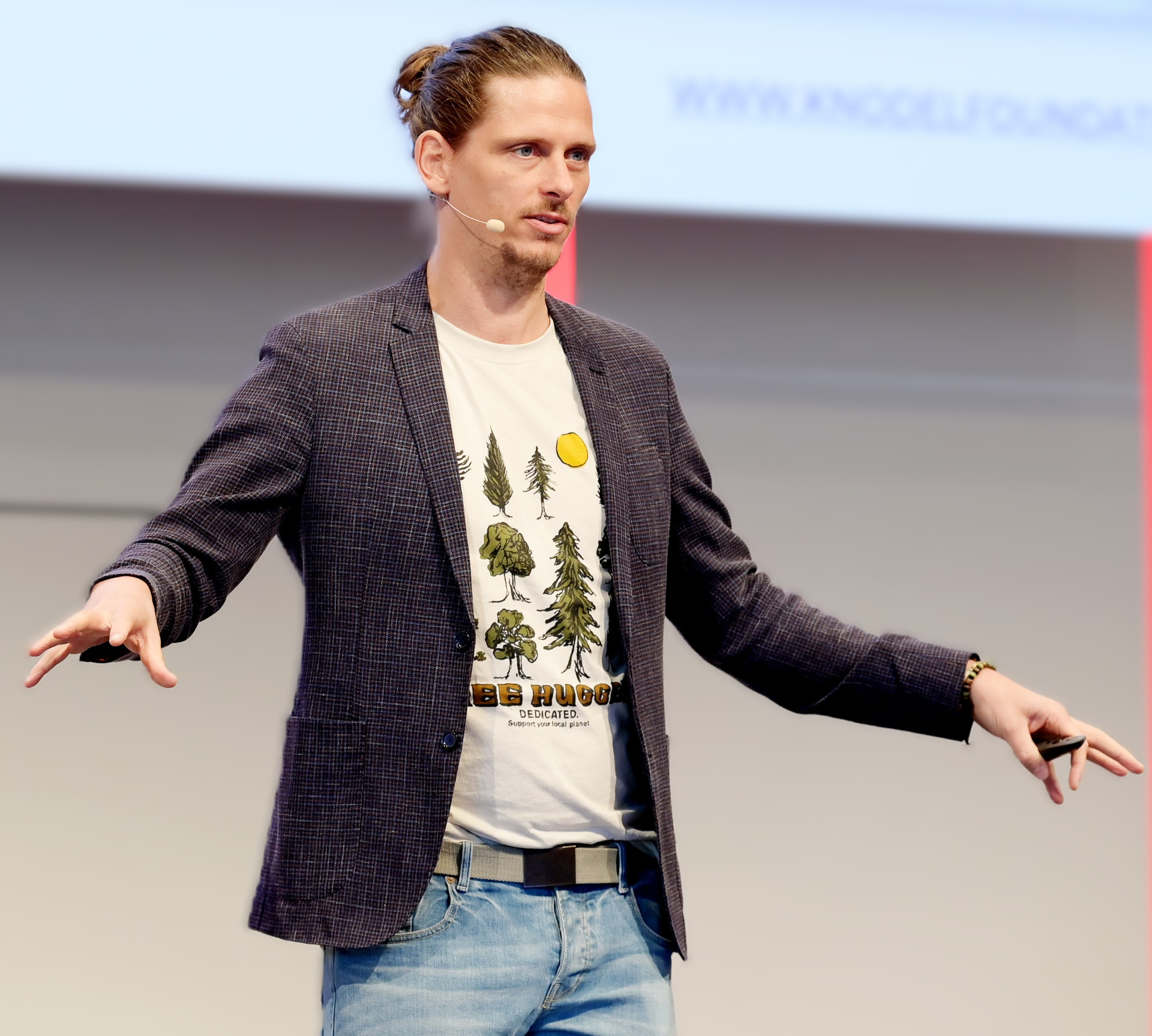

What shifted your thinking from conventional business to impact investing?
Seeing a reality that contradicted everything I had been taught. Travelling through Malaysia, I witnessed the scale of rainforest destruction caused by palm oil plantations firsthand. I then discovered two things: first, that many of the foods I ate contained palm oil; and second, after flying to London, that the investor behind the major Battersea Power Station development was the same Malaysian palm oil company connected to the destruction I had witnessed.
I had studied business at four universities across Germany and England, and the connection between consumer behaviour, capital flows, social behaviour and environmental destruction had never once been mentioned in any lecture. That gap in how we are being taught to look at the world with a western, extractive view, and the reality this creates for the planet, changed everything for me. I started reading books I would not have read before; I started talking to people from backgrounds that I had ignored before; and I realized my own ignorance — that, in fact, is part of western education and media models in general. A reductionist world view that sees every living organism purely as a “resource” to extract in order to reach an imaginary KPI called “return on invest” started to appear ridiculous to me.
How do you balance financial return with genuine social and ecological impact?
Two principles guide every decision.
First, the positive impact must be structurally embedded in the business model. Remove it and the model no longer functions. That eliminates greenwashing by design.
Second, founders must be authentically motivated by the problem they are solving, not by the existence of a market opportunity. Teams assembled from the outside because a sector looks attractive tend to be the first to abandon the mission when conditions become difficult.
Conviction has to be intrinsic. From an economic perspective, this also reduces the risk of default significantly, as purpose-driven founders refuse to let go before the job is done.
“The volume of capital flowing toward solutions that might allow this planet to remain habitable remains negligible compared to capital flowing in the opposite direction.”
What needs to change for impact investing to fulfil its potential?
It needs to become mainstream — and it must be honest.
The sector is currently dominated by the same exponential growth logic that is extractive by design and incompatible with natural systems. The “VC-model” funnels the winners into the same power structures and creates a battlefield of losses during the fight for the next “unicorn”. Not only what we fund creates impact, but also how the incentives of that company or fund are designed and how investors and entrepreneurs relate with each other. Alternative structures to create true “zebras” exist — steward ownership and evergreen funds among them — but adoption is slow.
The volume of capital flowing toward solutions that might allow this planet to remain habitable remains negligible compared to capital flowing in the opposite direction – especially when war becomes a profitable business in the current geopolitical framing: again.
The time for cautious evaluation has passed. Start now, with conviction, and build from there.
How do you see the role of philanthropy? Can impact investing replace it or are there areas where philanthropy can be truly impactful?
Philanthropy has a role to play and will always have, as long as we do not live in a perfect world, with perfect incentives in business, that are aligned with the doughnut model. Philanthropy partially has a bad reputation as being “inefficient” or even counterproductive. This view is not fully wrong, as many development schemes – especially state-funded but also run by big NPOs – have not been honest, not designed bottom-up, and many of them short-term funded.
At ChanceMaker Foundation, we are doing things differently. We believe that effective and sustainable change is best driven by the people who are directly confronted with the social and environmental challenges of our time in various ways. These people are structurally hindered in getting access to capital, so we fund (1) local ChanceMakers who (2) create local solutions on an organisational level (rather than just projects) (3) over several years to enable systemic change bottom-up. Most of these approaches would not be eligible for for-profit funding schemes, although social enterprises are part of the portfolio.
CONTRIBUTOR
Patrick Knodel — Founder, ChanceMaker Foundation; Managing Partner, INNOVATION for IMPACT GmbH. Patrick Knodel has spent two decades questioning the assumptions embedded in conventional capital. As Founder of the ChanceMaker Foundation and INNOVATION for IMPACT GmbH, he backs purpose-driven founders in the circular economy and the Global South, while challenging the idea that financial returns and planetary health are competing objectives.
FAMILY OFFICE SNAPSHOT
- Country
Germany
- Structure
Single family office, alongside INNOVATION for IMPACT GmbH and the ChanceMaker Foundation
- Investment Focus
Direct impact investment in early-stage, purpose-driven companies
- Emerging Interests
Circular economy, regenerative business models and steward ownership
- Geographic Focus
Europe and the Global South
- Philanthropy
ChanceMaker Foundation — education, opportunity and ecological restoration
CONTINUE THE DISCUSSION IN OXFORD
Patrick Knodel will join the UK Family Office Summit Oxford 2026 community at The Randolph Hotel on 24–25 November, bringing a perspective on impact investment, philanthropy, regenerative business models and purpose-driven capital.
Read the Oxford 2026 programme, see who attends and meet the 2026 speakers.
This article contains general information only and should not be construed as investment advice or a recommendation to invest. Investing involves risk, including possible loss of principal. Intended for sophisticated institutional and professional investors only.